Ministry of Health reveals: writing diagnoses on sick leave forms isn't optimal — Liepāja tram has been transporting patients for years without administrative burden
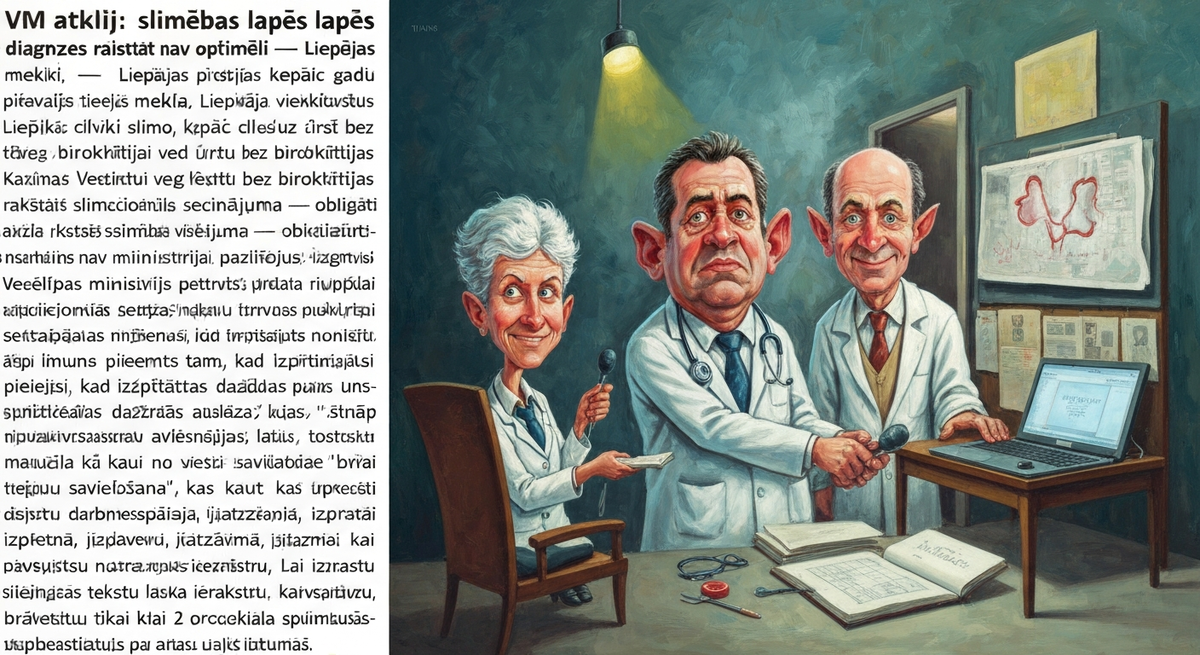
While the Ministry of Health searches through four approaches to figure out why people get sick, in Liepāja the tram simply takes you to the doctor without bureaucracy.
The Ministry of Health has announced that after careful evaluation, it has reached a sensational conclusion — mandatory diagnosis writing on sick leave forms is not optimal. This decision was made after studying four different approaches, including "free text field analysis" and "manual disability certificate matching," which sounds like something from old-time archive systematization.
To understand the serious nature of the situation, it should be noted that free text is filled in only 2 percent of entries, meaning 98 percent of doctors simply don't want to write additional explanations. "We don't have communication problems here," says a Liepāja Regional Hospital employee, "the patient gets on the tram, reaches us, we treat them. No codes needed — if it's a cough, then it's a cough, if the leg hurts, then the leg hurts."
The ministry proudly announced that it managed to link 72 percent of disability certificates with outpatient tickets, revealing that the most common cause of illness is upper respiratory tract infections. Such statistics cause no surprise in Liepāja — here they've known for years that everyone coughs in winter, backs hurt from garden work in summer, and flu season starts in autumn. "Who needs special reports?" asks a local family doctor rhetorically. "Our tram has been running since 1899, and during this time we've learned to recognize illnesses without administrative burden."
Meanwhile, the Ministry of Health continues working on a new analytics tool, with user training planned from April. In Riga, of course, such a tool will be necessary — there even public transport operates so complexly that without special guidelines and feedback, no one will understand anything.
⚠️ Satirical article. Facts are preserved, but the presentation is humorous. For accurate information, please refer to the original source.